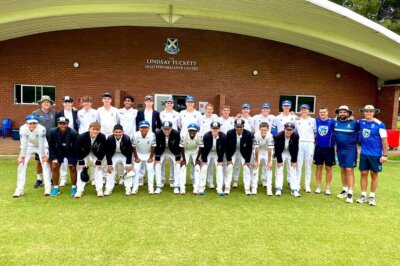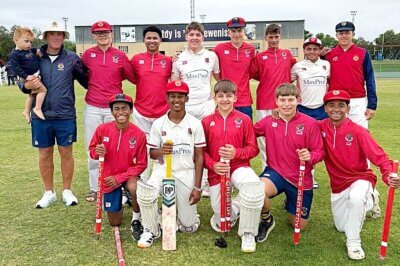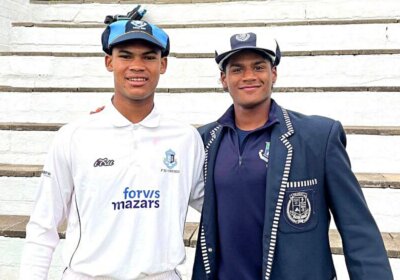
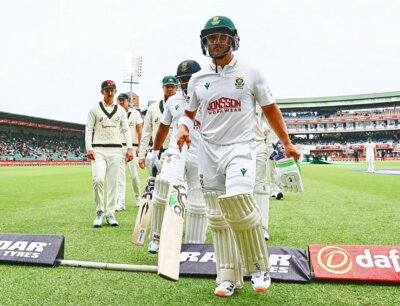
Marques Ackerman helped St Stithians College claim their place among the best cricket nurseries in the world when he walked out to bat against Australia at St George’s Park, in Gqeberha, on Sunday.
His inclusion in the playing XI for the second Test meant that for the fourth time ever, the Proteas had four players from the same school playing in the same Test match.
The first school to claim that distinction was Durban High School (DHS), which had four players – Trevor Goddard, Dennis Gamsy, Barry Richards, and Lee Irvine – in the teams that faced Australia in the first and second Tests in 1970. South Africa waited 55 years for the feat to be matched.
Last year, St Stithians’ Kagiso Rabada, Ryan Rickelton, Wiaan Mulder, and Kwena Maphaka were in the starting XI in the second Test against Pakistan in Gqeberha. St Stithians replicated the feat again on Sunday when Ackerman joined Rabada, Rickelton, and Mulder in the starting XI.
Ackerman played with all three during his time at St Stithians. He made his debut just as Rabada was rounding off his high school career, played with Rickelton for a significant period, and then shared the changing room with Mulder in his final years.

Saints has been one of South Africa’s leading cricket schools over the past 12 years. The institution, established in 1953, has produced eight Proteas players, with six of them making their international debuts between 2014 and October 2026. All six – Ackerman, Rabada, Mulder, Rickelton, Kwena Maphaka, and Lhuan-dre Pretorius – have represented South Africa in Test cricket.
The school hasn’t just produced top cricketers. It has also produced top coaches.
Wim Jansen, the St Stithians’ Director of Cricket, took up the role in 2008, when he arrived with two young coaches, Bongani Ndaba and Reuben Mandlazi. The duo furthered their studies as coaches and are now involved with the top franchises in the country. Among their many roles, Ndaba works with the Pretoria Capitals, while Mandlazi works with the Central Gauteng Lions.
The recent boom in cricketing talent leaving the gates of St Stithians and then excelling in the professional arena is partly due to a strong guiding philosophy and sporting culture.
“We’ve been fortunate to have some superb schoolmasters over the last 18 years since I’ve been involved,” Jansen said. “Guys like Fergus Gray, Philip Kuhn, Lee Cothill, Charles Coventry, and others have all played an instrumental role in this journey.”
Another factor is that while the school encourages its juniors to train hard, it also encourages them to play many matches. The philosophy is that time in the middle is more valuable than time spent in the nets.
“We believe that we need to practice the way we play. We need to up the intensity at practice,” Jansen explained.
“Often, practice can be very mundane. So we try to find ways to make practice very intense and like a match situation. We play as many games as possible. That’s really where the learning happens for many young cricketers.
“And then we have a number of middle practices, as opposed to just having arbitrary nets where we hit balls.”
The institution also has an exchange programme with various schools in the United Kingdom and Ireland, including King’s College in Somerset, Forest in London, Scarborough in Yorkshire, and Leinster Cricket in Dublin.
“All places where we exchange, boys go for a month-and-a-half to two months of the year. They play cricket in foreign conditions, away from their parents, coaches, and outside their comfort zones.
“We believe that’s a great way to grow these boys and to make them experience what it would be like to be a top-end cricketer early on,” Jansen said.
Matthew Katzenstein and Ombesa Matsha, who are part of the current first team, spent time in the UK honing their skills last year, while Thomas Rew, the captain of the England Lions team, spent time at St Stithians recently.
However, the most important ingredient for St Stithians is that they have tried to maintain a traditional structure as much as possible. They develop their school masters into coaches.
“We believe that the cricket field is an extension of the classroom. Ultimately, we teach boys through the sport of cricket. And at the end of the day, these are still schoolboys,” Jansen said.